
Private Label PDA Custom Branding: What MOQ, Tooling and Certification Really Cost
Private Label PDA Custom Branding: What MOQ, Tooling and Certification Really Cost
Private label PDA branding is not a logo swap — it is a transfer of legal manufacturer status. Under Article 2(1)(12) of the EU Radio Equipment Directive (RED), a “manufacturer” is any natural or legal person who markets radio equipment under his name or trade mark. The moment your logo goes onto a 4G or 5G handheld sold in Europe, you carry the manufacturer’s obligations, whoever injection-moulded the shell. The US works differently: the FCC grantee code stays permanently with the grant holder, and changing an FCC ID requires its own application. Both facts drive every number below.
The shortest honest version: branding-only programmes are cheap and can start at a few hundred units; opening a new mould, or putting your brand on a radio device sold in Europe, adds cost that dwarfs any unit-price difference you negotiated. Buyers who fight hard on price and ignore the paperwork are optimising the wrong term.
What does “private label PDA” actually mean in practice?
It means three very different things, and buyers routinely treat them as one. Level one is cosmetic: logo, colour, boot screen, pre-installed APK, retail box, user manual. Level two is firmware and configuration: key remapping, kiosk mode, MDM enrolment, system signature. Level three is hardware: a new enclosure, a different battery, an added UHF module, a gun grip, a different port layout.
Publicly published PDA tooling ranges from China cluster from roughly RMB 100,000–300,000 for a full new front-and-back shell, rising to RMB 200,000–400,000-plus for rugged overmoulded or dual-colour bodies, against a few thousand RMB when only the logo and colour change on an existing tool.
| Customisation level | What actually changes | Typical one-off cost | Main risk |
|---|---|---|---|
| Cosmetic (logo, box, boot screen) | Print, packaging, pre-installed apps | Low thousands or absorbed into unit price | Box shows your brand, certificate shows the factory — mismatch at customs |
| Firmware and configuration | MDM, key mapping, kiosk, SDK | Low thousands to tens of thousands | Firmware drift breaks scanner SDK on field upgrades |
| Hardware and enclosure | New shell, battery, UHF, grip, ports | RMB 100,000–400,000-plus in tooling alone | Re-opens radio and safety assessment |
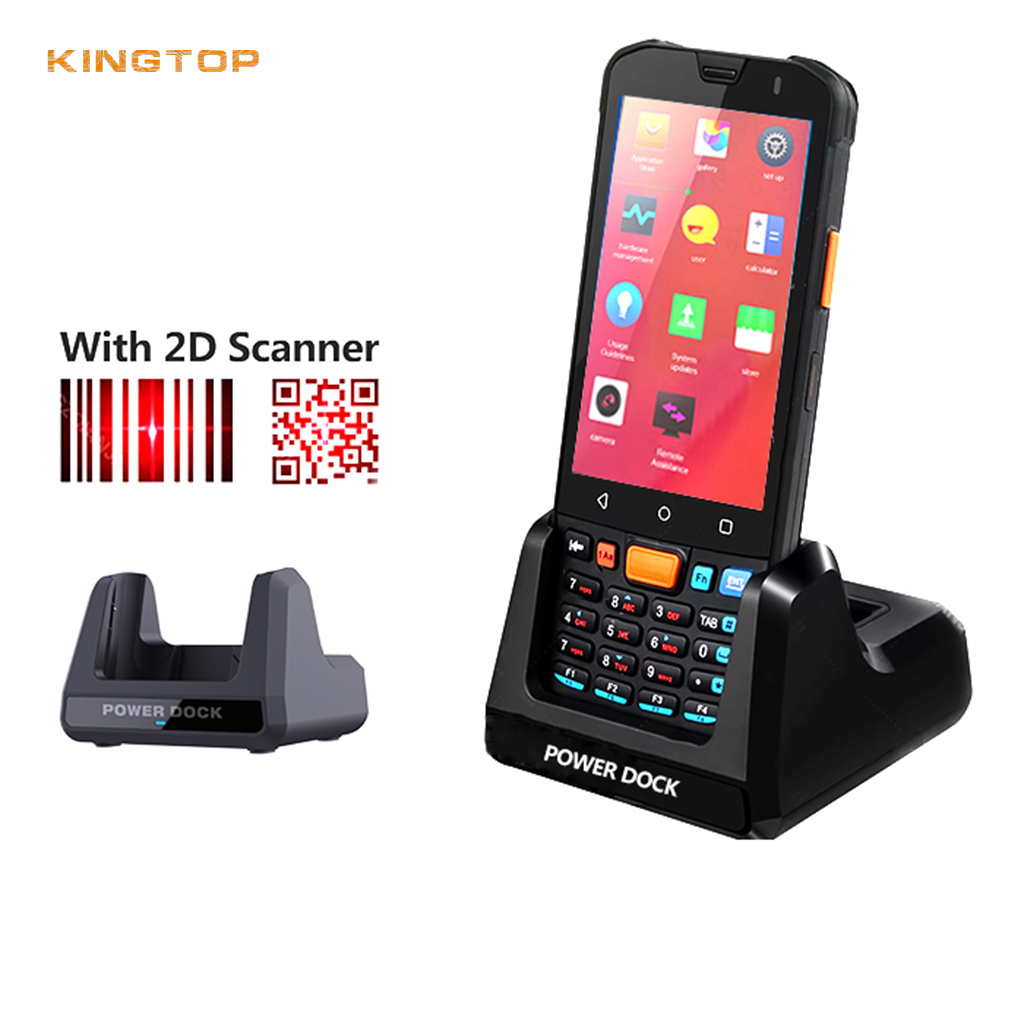
Kingtop is a China-based manufacturer of 5G PDA handhelds, mobile hotspots, POS terminals, body-worn cameras and rugged tablets, working across all three levels. The KP18 and KP26 families are the platforms most often used for level-two programmes, because the existing tooling already covers common battery and scanner configurations. The KP36 rugged handheld is the usual starting point when a programme needs a UHF variant or a pistol grip. Ask for a written scope of what changes — a level-two quote and a level-three quote should never look similar on paper.
How much MOQ does a private label PDA order actually need?
Published sourcing guidance puts an ODM-style shared-platform programme at roughly 100–500 units, and a full custom OEM programme at 1,000–5,000-plus units, because a dedicated tool has to be amortised across the whole run. On a mid-complexity device, tooling amortised over 500 units adds roughly $12.00 per unit; the same tooling spread over 5,000 units adds about $1.20 — a ten-fold swing driven by volume, not negotiation skill.
| Order size | Material cost | Amortised tooling | Ex-factory unit cost | Practical reading |
|---|---|---|---|---|
| 500 units | $12.00 | ~$12.00 | ~$29.00 | Tooling is half your landed cost |
| 1,000 units | $11.50 | ~$6.00 | ~$22.05 | The break-even most buyers hit |
| 5,000 units | $10.00 | ~$1.20 | ~$14.95 | Where tooling stops being the argument |
Two things worth saying plainly. First, MOQ is less negotiable than buyers assume — the factory’s constraint is material purchasing and a shared line slot, not attitude. Second, over-specification is more common and more expensive than under-specification. A buyer who pays for a bespoke shell, then orders 300 units, has paid five times the amortisation of one who bought a shared platform.
Platform choice matters more than any cosmetic detail. A rugged tablet programme often starts from the KT-KP12 rugged tablet platform and adds a private-label boot image, while a 5G handheld programme usually runs on the KP26 5G platform with custom key mapping and MDM enrolment. Both stay inside level-two customisation, which is why neither requires a new mould. Kingtop’s published MOQ depends on which level of change you are buying and which platform you start from; ask for the number against a specific platform rather than a generic figure.
Who becomes the manufacturer when you put your own logo on it?
You do, in the EU. Article 2(1)(12) of Directive 2014/53/EU defines the manufacturer as the person who “has radio equipment designed or manufactured, and markets that equipment under his name or trade mark.” This is the single most misunderstood clause in the whole sourcing process.
Once you are the manufacturer, Article 10 obligations attach to you: the equipment must carry your name, trade mark and contact postal address (Art. 10(7)), and you must hold the technical documentation and the EU declaration of conformity for ten years after placing the product on the market (Art. 10(4)). A contract clause saying the factory is responsible does not move that liability — regulators fine the entity named on the packaging. The workable route is a documentation pipeline: obtain the factory’s raw accredited test reports, verify they match your model and are current, then issue your own declaration of conformity in your company’s name.
Does the factory’s FCC ID cover a private label PDA sold in the US?
Usually yes, and this is the biggest asymmetry between the two markets. Under 47 CFR § 2.909(a), the party to whom the grant of certification is issued is responsible for compliance — that responsibility follows the grant, not the purchase order. A plain rebrand with no hardware change can ship under the factory’s existing FCC ID with the factory remaining responsible.
Three arrangements exist, and only one is about branding:
| Arrangement | FCC ID on the label | Who answers the FCC | What you need |
|---|---|---|---|
| Distributor / plain rebrand | Factory’s ID unchanged | The factory grantee | A written agreement naming who handles enquiries |
| Factory manufactures under its grant | Factory’s ID, per § 2.929(b) | The factory grantee, unchanged | Licence arrangement; second party must not be on the Covered List |
| You own the FCC ID | Your own ID via a change-in-identification under § 2.933 | Your company | Grantee’s written authorisation; test data not resubmitted if design is unchanged |
Note what § 2.933 does and does not allow: it lets you change the FCC Identifier without re-testing, but only where design, circuitry and construction are unchanged — and the original grantee can restrict that allowance in its own authorisation letter, so it is not a unilateral right. And § 2.926 is absolute on one point: a grantee code “is assigned permanently to applicants/grantees and is valid only for the party specified as the applicant/grantee.” Buying a factory does not transfer it; only the FCC reassigning it does. If you change the radio, antenna or power rating, § 2.1043(a) sends you outside the permissive-change classes entirely and back to a new grant.
How long does sampling and production actually take?
Published lead-time ranges cluster at 1–3 months from order to shipment for an ODM programme with shared tooling, and 6–18 months from concept to production for a full OEM programme, because the engineering phase — which an ODM catalogue skips entirely — is where the schedule is actually set. Certification adds to that: roughly $3,000–12,000 per SKU for CE and FCC-family work depending on complexity and markets, starting 8–14 weeks before intended market entry, not after.
Two practical rules. Book third-party pre-shipment inspection as a line item from the start, budgeted at roughly $200–500 per shipment. And treat the sample batch as the compliance gate, not the marketing sample: verify your documentation against actual pilot units before committing to a production-sized order.
Frequently asked questions about private label PDA programmes
Do I need my own FCC certification if I only change the logo?
No, if the device is electrically identical and you sell under the factory’s existing grant. Your brand sits on the box while the factory’s FCC ID stays on the label and the factory remains responsible to the Commission. You need your own FCC ID if you want control over later design changes, or if you changed the radio, the antenna or the power rating.
Can I sell the same factory device under two different brands?
Both can be compliant, but only if each seller independently holds its own technical documentation and issues its own declaration of conformity. Neither can rely on the other’s file, and neither can rely on the product merely being on the market with a CE mark on it.
Is private labelling cheaper than OEM?
Per unit at low volume, yes; in total cost of ownership, usually not. ODM keeps NRE and tooling low and you pay a per-unit premium. OEM costs more upfront and gives you design control with no IP licensing built into the price. The crossover is volume: if your advantage is speed and brand, ODM; if it is something a competitor cannot copy, OEM.
What is the smallest sensible first order?
On a shared platform, a few hundred units is realistic and lets you validate demand before touching tooling. Below that, ask whether you are optimising your supply chain or your balance sheet — the answer changes which programme you should be on.
Talk to Kingtop about your programme
Kingtop is a China-based manufacturer of 5G PDA handhelds, mobile hotspots, POS terminals, body-worn cameras and rugged tablets. Certification scope, including CE RED, FCC ID, ISO 9001 and 14001, and payment-terminal approvals, is documented on our credentials page. For a private label programme, start with a written scope of changes, a platform-specific MOQ and a documentation plan — then compare it against the other quotations on your desk. Browse the Kingtop product range, or send an enquiry with your target configuration and volumes.

About the author: Written by the Kingtop Product Team, which handles product specification and OEM/ODM programme support. Last updated: 11 October 2026. Editorial policy: Kingtop publishes technical sourcing guidance written by our own engineering and product staff. Product claims come from our own datasheets; regulatory references link to primary legal texts (EU Directive 2014/53/EU, 47 CFR Part 2). We do not publish competitor specification data we cannot trace to a public source, and we correct errors when readers supply them.

About author




Add comment